What routine work really costs your business, and how to calculate it in three minutes
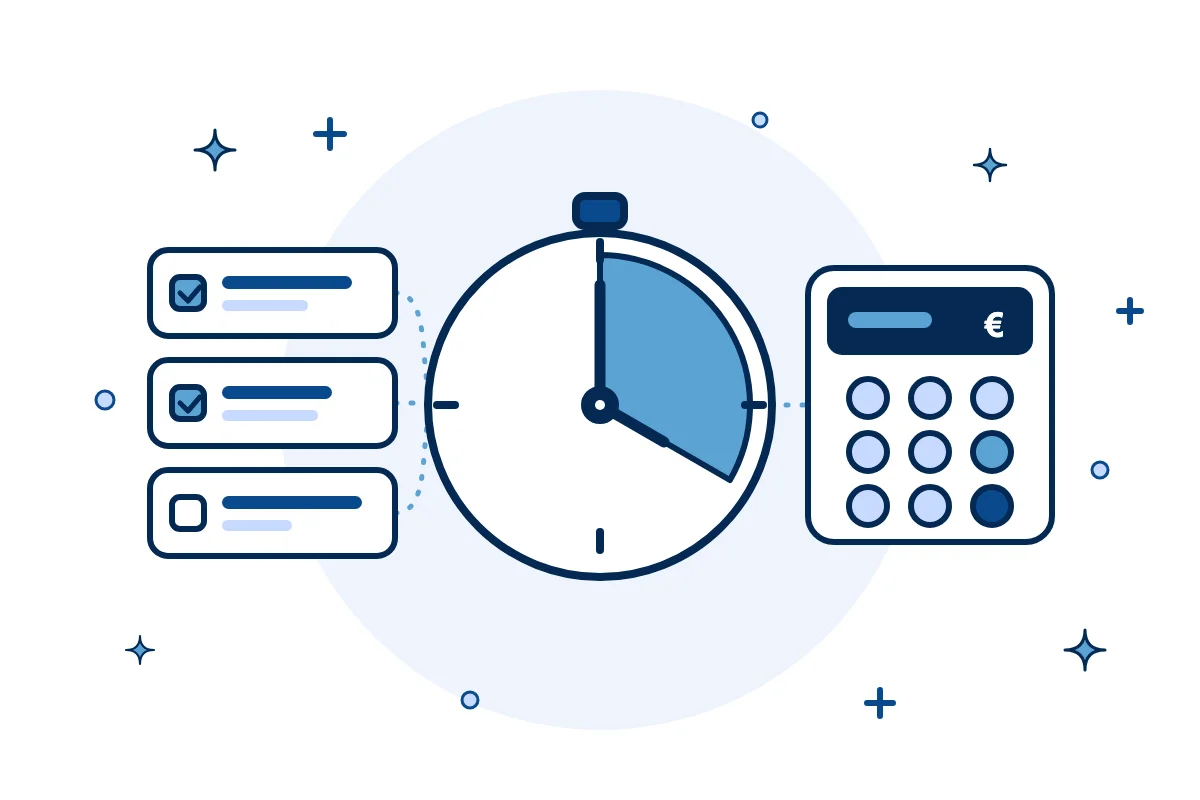
Nobody budgets for retyping data, chasing replies or building the same report every Monday, because each task is small. Added up across a team and a year, they are one of the biggest costs in a small company. Here is how to put a number on it, and a free calculator that does the arithmetic for you.
Routine work rarely shows up as a line in the accounts. It hides in ten minutes here and a quarter of an hour there, spread across several people, and it feels like “just part of the job”. Because no single instance hurts, nobody asks what the whole pile costs.
That is the problem. You cannot decide what is worth improving until you know what it costs, and a rough number is far better than none. The good news is that the arithmetic is simple.
The formula
For every recurring task, you only need two estimates, counted across the whole business and not per person:
How often the task happens per week.
How many minutes one occurrence takes.
Multiply the two to get minutes per week, divide by 60 for hours per week, and multiply by about 46 working weeks to allow for holidays and absences.
Multiply the yearly hours by the cost of one working hour.
For the hourly cost, use salary plus employer costs and a share of overhead, not just the gross hourly wage. A rough all-in figure is fine, and it is better to be roughly right than precisely wrong.
A worked example
Take a ten-person services company and three tasks that nobody has ever measured:
Retyping orders from e-mail into the ERP: 25 times a week, 8 minutes each, which is 200 minutes.
Chasing late payments: 10 times a week, 15 minutes each, which is 150 minutes.
Building the weekly sales report from three exports: once a week, 120 minutes.
That adds up to 470 minutes a week, almost 8 hours. Over 46 working weeks it is about 360 hours a year, or around 45 working days. At an all-in cost of 45 € per hour, these three small tasks cost roughly 16,200 € a year.
Where the hours usually hide
If you are not sure where to look, these are the places where we most often find routine work in small companies:
Re-typing the same data between e-mail, spreadsheets, accounting, CRM or ERP.
Sorting and answering enquiries, especially the same questions again and again.
Finding and filing documents, attachments and contracts.
Chasing people: reminders, status checks and follow-up e-mails.
Coordinating appointments: scheduling, rescheduling and confirming.
Preparing quotes and invoices by collecting data and building documents by hand.
Building lists and reports from several sources.
Internal questions and approvals, which mostly means waiting for an answer.
How much of it can be automated?
Not all of it, and anyone who promises otherwise is selling something. Our experience is that tasks made of fixed rules and structured data, such as moving data between systems or producing a standard report, can often be reduced by well over half. Tasks that need judgement, such as answering unusual enquiries or approving exceptions, tend to save less, because a person still has to decide.
In the example above, a realistic outcome is roughly 205 to 295 hours a year freed up, worth about 9,200 to 13,300 € at the same hourly cost. Treat figures like these as a range and a reason to look closer, not as a promise: they depend on how your processes actually run.
Four mistakes that skew the number
Counting the same time twice. If a task takes 10 minutes and appears in two categories, it is still 10 minutes.
Counting one person only. Estimate across the whole business, including the person who “just does it quickly” for everyone.
Guessing high out of frustration. Estimates drift upward for tasks people dislike. If you can, time one or two real occurrences with a stopwatch instead of guessing.
Using the wage instead of the full cost. Employer costs and overhead make an hour more expensive than the payslip suggests.
What to do with the number
Once you have it, start with the one task that costs the most and follows the clearest rules, not with the one that feels most annoying. Our guide on what to automate first in a small company gives a simple filter for choosing it.
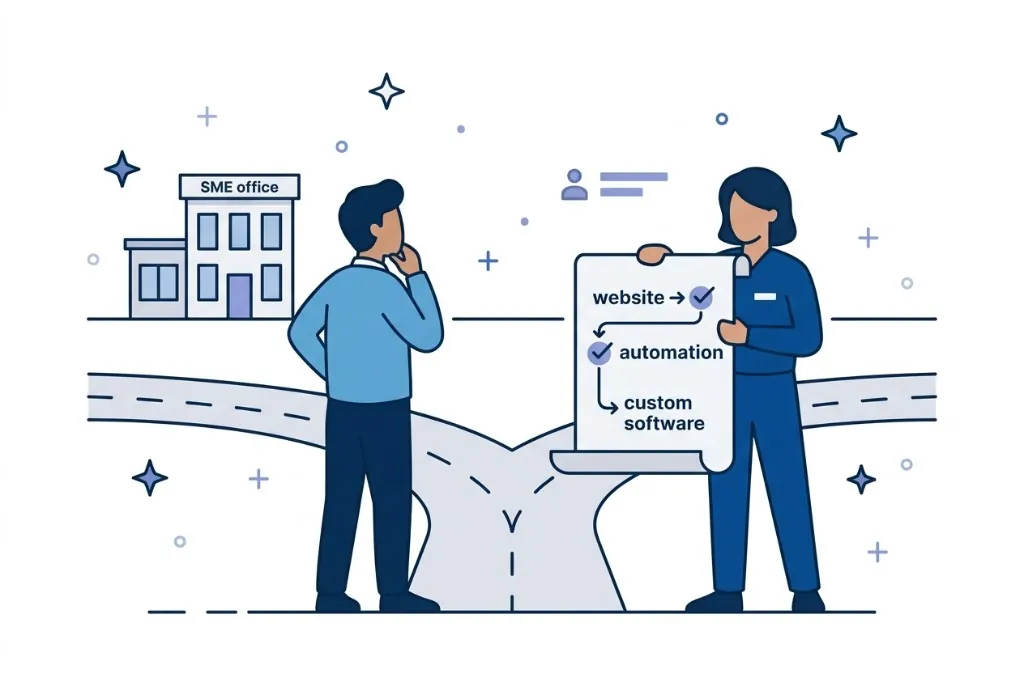
If the hours justify it, the next step is a conversation about what automation would involve, from simple integrations to custom software. See how we approach process automation, and check whether part of the cost could be covered through SME Packages Digital.
See your own number
Answer a few questions about your tasks and get the hours and euros routine work takes in your business. It is free and needs no sign-up.
For SMEs, digitalization is essential for staying competitive. Learn why a digitalization partner matters and how NexClass supports small and medium enterprises through web development, automation, and software solutions.