Custom software vs ERP: what Luxembourg SMEs actually need
When an SME says “we need an ERP”, they usually mean something more specific: work is scattered across Excel, email, and one person’s head, and it is starting to break. A packaged ERP can be the right answer. Often it is not. The cheaper, safer first step is to name the bottleneck and choose between three options — live with spreadsheets, buy a package, or build a focused system.
Software SME Luxembourg
Published on Aug 11, 2026•9–11 min read
The real system is usually Excel plus people
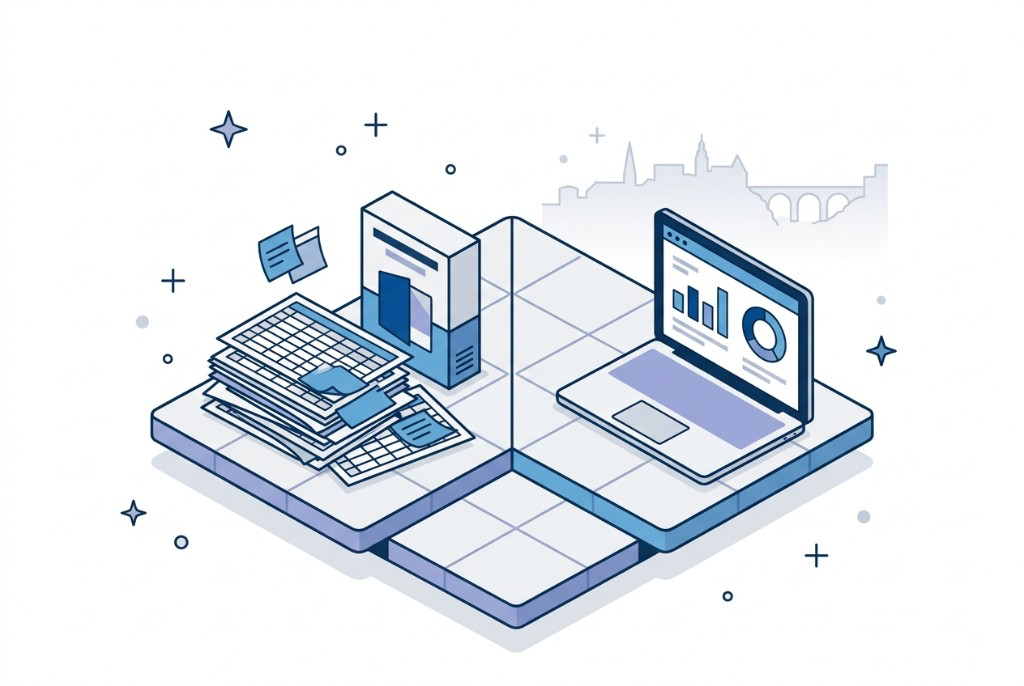
In a 10–80 person company in Luxembourg, the “system of record” is rarely a single product. Accounting lives in a certified package. Sales lives in a CRM, or in inboxes. Operations live in shared drives: delivery lists, membership files, job cards, stock counts, follow-ups. The glue is a handful of people who know which tab is the truth this week.
That works until it does not. A key person is on leave. Two files disagree. A client asks for a status and nobody can answer without a hunt. At that point “ERP” sounds like the adult solution. What you actually need is a reliable place for one operational process — not a platform that claims to run the whole company.
Three options, not two
Treat the choice as a triangle. Each corner is valid.
Stay on spreadsheets when the process is still changing every month, only one person uses it, and errors are cheap. Buying or building software on a moving target is how projects stall.
Buy a package when the process is a known commodity: accounting, payroll, HR, a cash register, a well-known industry tool. You want compliance and a vendor who already did the boring work.
Build a focused system when the process is how you compete, or when three tools already exist and none of them talk. You are not buying “an ERP”. You are replacing a specific bottleneck.
When off-the-shelf wins
Packaged software is the right call more often than agencies admit. Use it when:
The job is legally constrained (accounting, e-invoicing modules, payroll).
Your industry already has a tool everyone expects you to use.
You can live with 80% fit and will not spend years customising the last 20%.
You need a vendor roadmap, not a one-off codebase.
The failure mode is the opposite: buying a large ERP, then paying for months of configuration so it matches a process the vendor never designed for. You end up with a heavy system that still needs Excel on the side.
When custom wins
Custom software earns its keep in a narrower set of cases — and those cases are common in SMEs:
Your process is the product : how you schedule jobs, handle members, run a back office, or coordinate between sites.
Two to five people lose hours every week to retyping between systems that will never be replaced.
The data is sensitive or Luxembourg-specific enough that a generic SaaS workflow is a poor fit.
You need a first version that a small team will actually use, not a 40-module suite that nobody finishes implementing.
A good custom tool is boring on purpose: one workflow, clear ownership, something you can maintain. That is closer to software we build for SMEs than to a classic ERP RFP.
Cost and risk in SME terms
Full ERP programmes fail in small companies for boring reasons: the licence looks affordable, the implementation is not, and the organisation cannot pause operations for a six-month data-migration theatre. Custom work has the opposite risk — an open-ended build. The antidote is a hard scope.
In Luxembourg, a first operational tool often sits in the SME Packages – Digital range (€3,000–€25,000 excl. VAT, with 70% reimbursement of eligible costs if the authorities approve). That budget will not replace your accounting stack. It can replace the Excel that sits next to it. That is usually the higher-leverage move.
A useful test: if you cannot describe the first release in one paragraph — who uses it, what they stop doing in Excel, what “done” looks like — you are not ready to buy an ERP either. You are still discovering the process.
A practical way to decide
Write down the process that hurts, not the software category you think you need.
Count how many people touch it weekly, and what an error costs.
Check whether a known package already covers 80% without twisting it.
If not, scope a custom slice that one team can run in 90 days — then stop. More can come later.
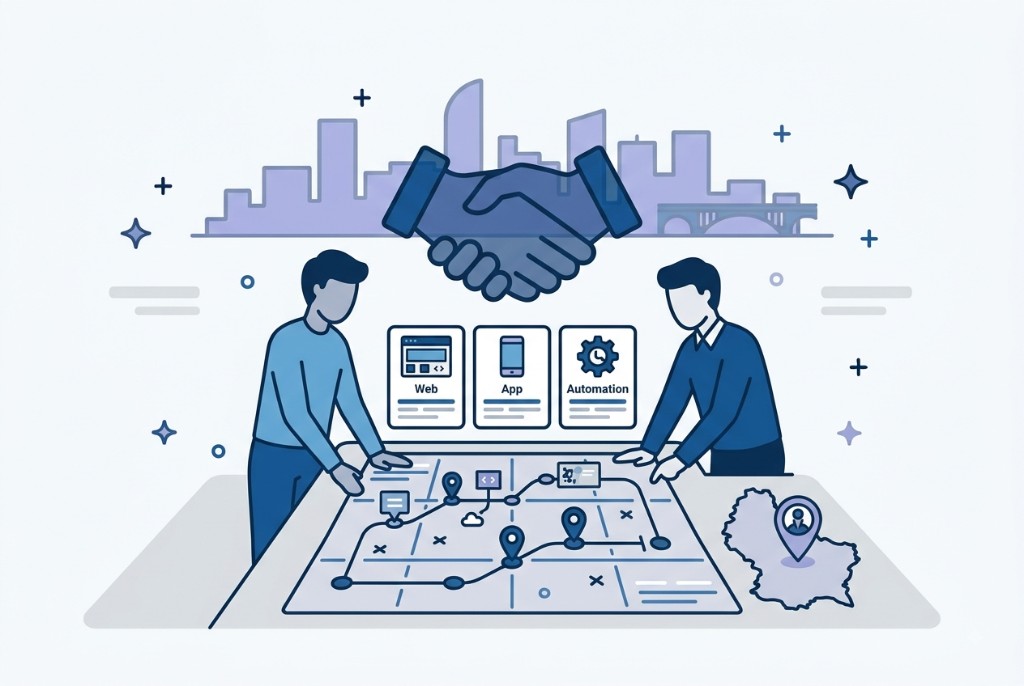
That sequence is how we work with Luxembourg SMEs on custom software and automation . We would rather tell you to buy accounting software than pretend a custom ERP is a weekend project.
Not sure which side you are on?
Bring the process, not a product name. We will tell you if a package, a small custom tool, or more Excel for now is the honest answer.
Self-hosting a model is a data-flow decision, not a compliance certificate. What GDPR actually asks of an AI system, when a local model earns its cost, and how to route by data class.
Warum ein Software Unternehmen in Luxemburg der richtige Partner für Ihre digitale Transformation ist – von individueller Entwicklung bis zu skalierbaren Lösungen.
Plutôt que de remplacer votre ERP, un module spécialisé peut combler le point précis qui vous coûte du temps — moins cher, plus rapide, sans migration complète.